
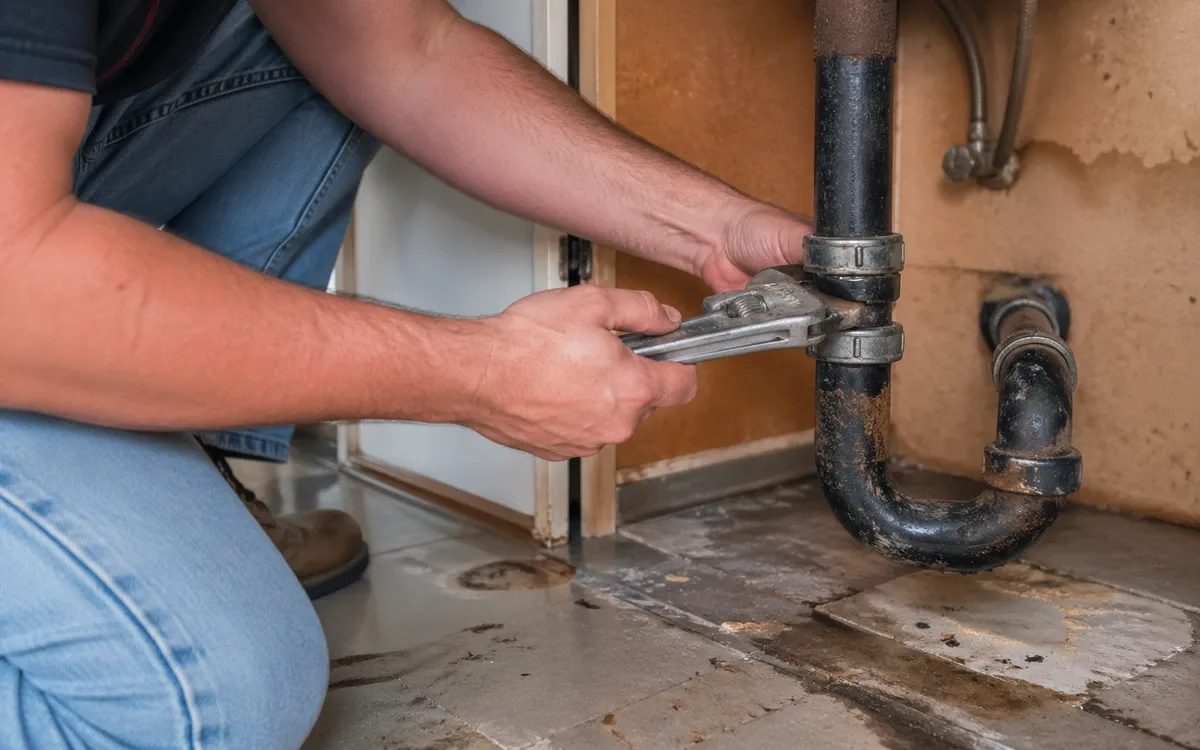
Yes — as a general rule, a standard general liability policy is built to answer third-party water damage that surfaces after you have finished a plumbing job, because that exposure lives inside a defined part of the policy called the products-completed operations hazard. The classic claim is a fitting, valve, or supply line you installed that lets go weeks or months after final payment and floods a finished space that belongs to someone else. That third-party property damage — the ruined ceiling, the soaked flooring and stock in the unit below — is exactly what completed-operations general liability is there for.
The qualifier worth understanding is what “after the job” does to the timing question. A leak that shows up long after your crew demobilized raises a coverage-trigger issue, and the answer depends on whether your policy is written on an occurrence basis or a claims-made basis. This post explains what completed operations actually covers, why the occurrence-versus-claims-made distinction decides which policy year answers, and where the line sits between damage to someone else’s property — covered — and reworking your own defective plumbing, which is a different question entirely. The general liability page owns the full coverage architecture; this post zooms in on the completed-operations water-damage tail that is plumbing’s signature exposure.
What “completed operations” actually means
Every general liability policy divides your work into two windows. While your crew is on the job and the work is in progress, that is your ongoing operations. Once the plumbing is installed, tested, and signed off — once you have finished and left the site — the work moves into what the policy calls completed operations. The formal home for that exposure inside the commercial general liability form is a defined term: the products-completed operations hazard. It is not a rider you bolt on; it is a category built into the standard policy that gathers up liability for damage arising from your work after you are done with it.
For most trades the completed-operations window is quiet. For plumbing it is where the signature claim lives. A connection you install or repair keeps existing long after final payment: it holds pressure, cycles hot and cold, freezes and thaws, and ages behind a finished wall or under a slab. When it fails, the water does not respect the fact that you left months ago. That is why a plumbing contractor has to understand completed operations as the part of the policy that matters most, not a footnote — the exposure it covers is exactly the one your trade is most likely to generate.
Third-party property damage is the piece that gets answered
The heart of the coverage question is whose property got wet. A completed-operations general liability claim is about damage your finished work causes to someone else’s property or person. When a supply-line connection behind a finished wall fails and water runs down through the drywall, the flooring, and the tenant’s inventory on the level below, that is third-party property damage — and it is what the products-completed operations hazard is built to answer.
This is worth stating plainly because it is where a lot of confusion starts. The policy is not a warranty on your plumbing. It does not exist to guarantee the fitting holds. It exists to respond when the fitting fails and, in failing, damages property that is not yours. The finished ceiling, the ruined hardwood, the water-logged stock, the business-interruption claim from the tenant below — those are the third-party losses completed-operations general liability is designed for. Keep that frame and most of the coverage picture falls into place.
Occurrence versus claims-made: which policy year answers
Here is the distinction that decides everything once a job is behind you. General liability is written on one of two triggers, and for a trade with a long completed-operations tail, the difference is not academic.
- An occurrence policy responds based on when the damage or occurrence took place — whether a policy was in force at that moment. If the supply line let go and flooded the space in a given year, that year’s policy is the one meant to answer, even if you are now insured elsewhere or the policy has since lapsed.
- A claims-made policy responds based on when the claim is first made or reported to the insurer. The claim has to land while the coverage is active, and it has to fall after the policy’s retroactive date, or an old job can be stranded.
In ISO’s system the standard occurrence version is often referenced as CG 00 01, and the claims-made version as CG 00 02 — but editions and exact forms vary by carrier, so treat those as the family names of the two triggers, not a guarantee of what is stapled into your policy. What matters is that you know which basis you are on. For plumbing, where the completed-operations leak can surface a year or several years after the work, the occurrence basis lines up naturally with the exposure: the year the damage happened is the year that answers.
Where the completed-operations tail runs long
Plumbing’s completed-operations exposure does not close when the invoice clears. A fitting that lets go two months after final inspection, a valve that fails and floods the finished space below, or a supply line that seeps until it ruins drywall and flooring is the classic completed-operations claim — and it usually surfaces long after the crew has left the site. That tail is why the trigger matters so much: the damage and the claim can be separated by a year or more.
On an occurrence policy, that separation is manageable, because the policy in force when the damage happened is the one that answers. If you switch carriers, the old carrier still stands behind the year it covered. On a claims-made policy, the same late claim can fall into a gap unless continuity is maintained and the retroactive date reaches back far enough to pick up the old job. This is the practical reason many contractors treat the trigger as a decision to make deliberately rather than inherit by accident. It is worth reading the completed-operations language on your own policy against the way your trade actually generates claims.
Where the “your work” line is drawn
Here is the boundary that trips up more plumbing contractors than any other. Completed-operations general liability answers the damage your finished work does to other property. It does not pay to tear out and redo the defective plumbing itself. If the fitting you installed fails and floods the ceiling below, the policy is built to answer the ruined ceiling, the soaked contents, and the third party’s loss — not the cost of replacing the faulty fitting or reworking the line you got wrong. That second piece is the separate “your work” question, and it is generally excluded from general liability by design.
The distinction is clean once you hold both halves at once: damage to someone else’s property from your completed plumbing is the covered side; redoing your own defective plumbing is the excluded side. This post is about the first half. For the second half — why redoing your own faulty work is carved out, and what that means for how you price and warranty a job — read the “your work” exclusion, which owns that side of the line. Keeping the two straight is the difference between understanding your policy and being surprised by it.
Real-World Scenario: A plumbing contractor finishes the supply and drain lines on a commercial tenant build-out, passes final inspection, and demobilizes. More than a year later a supply-line connection behind a finished wall lets go; water runs through two floors and ruins finished ceilings, flooring, and a tenant’s stock below. The property-damage claim names the plumber. Because the policy was written on an occurrence basis, the year the damage happened is the year that answers, even though the job was long closed — and the completed-operations coverage inside the products-completed operations hazard responded to the third party’s ruined property. What the policy did not do, and was never meant to do, was pay to replace the failed connection itself; that faulty fitting was the plumber’s own work.
What completed-operations coverage does not stretch to
Completed operations answers a specific thing — third-party property damage or injury from your finished plumbing — and it is worth being clear about what sits outside it. It does not reach your own crew: injuries to your workers run through workers compensation, a separate line. It does not answer your vehicles, which run through commercial auto, or your tools and drain machines, which run through contractors equipment. And it does not, on its own, resolve a sewage or contaminant release, which the standard policy tends to carve out into a pollution question. Completed-operations general liability is one important piece of the picture, not the whole of it.
It also does not erase the timing homework. Knowing you have completed-operations coverage is only half the answer; knowing which trigger you are on, and whether your retroactive date and continuity protect the jobs already behind you, is the other half. For a trade that generates claims years after the work, that homework is the part worth doing before a claim forces it.
Read your policy before the leak forces the question
The takeaway is straightforward. A standard general liability policy is built to answer third-party water damage from your completed plumbing, and that exposure lives inside the products-completed operations hazard — the defined home for liability that surfaces after you have finished. What decides which policy year answers is whether you are written on an occurrence or a claims-made basis, and for a trade whose leaks surface late, that trigger is the piece worth understanding before a claim tests it. The policy answers damage to someone else’s property; it does not pay to redo your own defective work. Editions and exact forms vary by carrier, so read the completed-operations language on your own policy rather than assume it works the way you expect. When you are ready, start a quote and tell us how far back your completed work runs, read the full general liability page to see how the completed-operations coverage fits the rest of the policy, or browse the coverage overview to see where each line sits.