Coverage line
General Liability Insurance for Plumbing Contractors
The foundation policy for a plumbing business — and the exposure that defines the trade: a fitting, connection, or valve that fails after the job and floods a finished space. The completed-operations side of general liability is built to answer for it, alongside the severity of gas-line work.

General liability is the coverage that answers for the people and property around your work — not your own crew, and not your own tools, trucks, or materials, but everyone else who can be hurt or have something damaged because of what your plumbing business does and what it leaves behind. For a plumbing contractor it is the foundation policy: the one general contractors and building owners want to see first, the one your certificate-of-insurance and additional-insured requirements are built on, and the one that decides whether a third-party claim is a phone call or a bill you pay out of pocket.
But plumbing carries an exposure that sets it apart from most businesses, and it is the reason this is the signature general-liability page rather than a generic one. It is the work you leave behind: a fitting, a connection, a valve, or a supply line that fails after the job is finished and floods a finished space — a slow leak behind a wall discovered months later, a ceiling that collapses in the unit below, water that spreads across a multi-tenant floor. A second exposure sits at the severe end of the operation: gas-line work, where a failure carries consequences well beyond a water loss. This page covers the everyday third-party exposure up top, then gives water-damage completed operations its own deep section, treats gas-line severity, names the additional-insured endorsements a general contractor will demand of you, and finally draws the honest seams where general liability stops — most importantly the pollution seam, the reason a plumbing program needs a separate line for sewage and contaminant releases.
Third-party bodily injury and property damage on the job
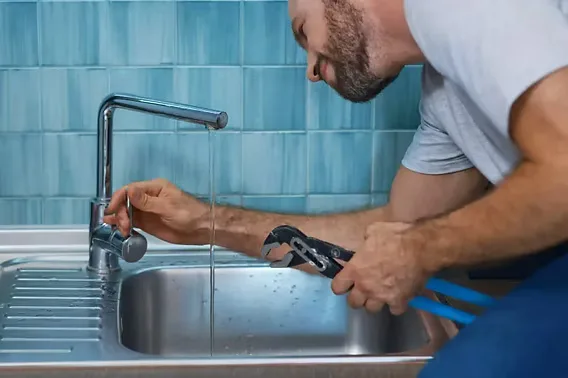
Before the signature exposure, general liability answers for the ordinary third-party risk of running plumbing work where the public and other trades are around. A building owner, a tenant, a delivery driver, or another contractor’s worker hurt around your job — slipping on water tracked across a finished floor, struck by a dropped tool or a length of pipe — is a third-party bodily-injury claim, and general liability is built to respond to it and to the legal defense that comes with it.
The same is true of damage you do to property that is not yours. A drain you snake that pushes water back into a finished basement, a supply line left open that floods a unit during a service call, a fixture set wrong that overflows onto the floor below, equipment that gouges a finished wall — these are third-party property-damage claims that arise around the operation, and general liability responds to them. What it draws a careful line around is damage to your own work and the cost of redoing it — which is where the completed-operations section picks up.
The signature exposure (1): water damage from your completed work
This is the section worth slowing down on, because completed operations is the loss that defines plumbing and the one owners most often misunderstand. Almost every business carries some general-liability exposure; few carry the completed-operations tail the way a plumbing contractor does, because the connections you make keep holding pressure — or slowly failing — long after you collect final payment, and a failure in a finished space can turn into a serious third-party loss months or years later, often in a part of the building you will never see.
The standard commercial general liability policy answers for this through what it calls the products-completed operations hazard. In the standard ISO coverage form — the one most general liability policies start from, typically the occurrence-based form known as CG 00 01 — that hazard is a defined term: it covers bodily injury and property damage arising out of “your work,” occurring away from your premises, once the work is complete. For a contractor, the finished installation is “your work” — this is the completed-WORK mechanism, not a product made and shipped off a line — and for a plumbing business it is the heart of why the coverage matters.
The scenarios it is built for are specific and serious:
- A connection fails and floods what is below. A supply line, a fitting, or a solder joint that lets go after the job is done, sending water into the ceiling, the finishes, and the contents of the space below — the classic completed-operations plumbing claim, and one that often surfaces long after the crew has left.
- A slow leak works for months before anyone finds it. A weeping fitting or a pinhole behind a wall that runs undetected, rotting framing and growing damage until it finally shows — the loss that makes the long tail of this exposure so real.
- Water spreads across a multi-unit building. On commercial and multi-tenant work, a single failed connection can run down through several units, and the third-party damage compounds floor by floor.
- A failure traced back up the chain. Your completed work is blamed for damage elsewhere in the building, and the claim follows your installation back to you long after substantial completion.
Now the trigger nuance that trips owners up, and the one we walk every contractor through. The standard CG 00 01 form is written on an occurrence basis — it responds to bodily injury or property damage that occurs during the policy period, regardless of when the claim is finally made, even years later. There is also a claims-made version, the CG 00 02 form, which responds based on when the claim is reported and depends on continuous coverage and retroactive dates. Because a leak or a failed connection can surface a long time after the job, the long-tail nature of this exposure usually makes occurrence-based coverage valuable to a contractor — but the form your policy actually uses is something to read before a loss, not during one, and we check it against the work you do.
There is a second line underneath the first, and it is constantly misread. Completed operations responds to the third-party harm your failed work causes — the space flooded, the ceiling ruined, the contents destroyed by the water your connection let go. It does not simply pay to tear out and redo your own defective work because it failed: the standard form carries exclusions, framed around “your work,” that treat redoing your own installation as a business cost rather than a covered third-party claim. The resulting damage to others is the insured event; the rebuild of your own failed connection is not. Getting that line right before a claim — and structuring the program with it in mind — is exactly the work we do with a plumbing business rather than letting an owner assume the policy makes them whole on their own callbacks.
The products-completed operations aggregate
The structural point a contractor has to understand is the limit. General liability does not carry one single cap; it carries several, and completed-work claims draw against their own. The products-completed operations aggregate is a separate limit bucket — distinct from the general aggregate that responds to the on-site, in-progress claims — and it is the cap that the serious completed-operations losses erode. For a plumbing contractor that is the number to watch, because this is a class where that bucket actually gets used: water damage discovered a season or two after the job draws against it.
Because the products-completed operations aggregate is separate and finite, a contractor with real completed-work exposure — or one whose contracts demand higher limits — often layers umbrella liability above the primary policy to add limit over both aggregates. Reading how your policy treats that aggregate, and whether it is adequate for the work you take on, is exactly the kind of check we do before binding rather than discovering during a claim.
The signature exposure (2): gas-line work and the severe end of the operation
The second exposure sits at the severe end of a plumbing operation, and it belongs to the contractors who install and repair gas lines. A water leak is a costly loss; a gas-line failure is a different order of severity, because a leak, a bad connection, or a failed shutoff can lead to fire or explosion rather than water damage — third-party bodily injury and property damage of the most serious kind. For a contractor doing gas work, this is the exposure that concentrates the risk on the general liability program.
We describe this exposure plainly and without dressing it in statistics, because it does not need them: a gas-line failure is among the most serious losses a plumbing contractor can cause, and general liability is built to respond to the third-party bodily injury and property damage that results — the building and contents that are not yours, and the people who are not your employees. The prevention side — pressure testing, proper joint work, following the code and the gas utility’s requirements, and documenting the work — sits alongside the coverage rather than in place of it. It is worth naming plainly that this, like the everyday premises risk, is an operations exposure that can also carry a completed-operations tail: a connection that fails later is “your work” just as a water fitting is.
Additional insured: the endorsements your general contractor will require
Plumbing contractors rarely work alone on commercial and new-construction jobs — most work as a sub under a general contractor or for a building owner whose contract dictates the insurance terms. One of the first things that contract will demand is additional-insured status on your general liability, and getting the endorsements right is what keeps a coverage requirement from stalling a job or costing you the account.
In ISO’s system this is typically handled with two endorsements, and a well-drafted contract usually requires both:
- CG 20 10 — ongoing operations. Adds the general contractor (or owner) as an additional insured for your ongoing operations — the protection they want for the duration of the work, while your crews are on the job.
- CG 20 37 — completed operations. Extends that additional-insured status to your completed operations — the protection the GC wants after your plumbing work is finished, which matters precisely because plumbing carries the long completed-operations tail described above.
The pair matters: CG 20 10 alone protects the GC while you are working but can leave them without additional-insured status once you have wrapped up — and the completed-operations tail is exactly when a plumbing claim tends to surface. Many policies can add these on a blanket basis — additional-insured status “where a written contract requires it” — rather than scheduling each general contractor by name, which is far more practical for a sub bidding multiple jobs. But whether your policy carries blanket additional-insured wording, whether it includes the completed-operations endorsement, and at what limits, all depend on the endorsements actually attached to your policy. Reading your contracts against your endorsements is work we do before binding, not after a certificate request lands on your desk.
Where general liability stops: the seams that matter
Some exposures look like they should be covered here and are not, and naming them honestly is the whole point — because a plumbing contractor who assumes general liability answers for everything finds the gap during a claim. General liability covers the work you do and the harm it can cause to third parties. Several neighbors pick up where it stops, and the first is the one that defines this brand.
The pollution seam — pollution liability. This is the seam that matters most for a plumbing business, because the exposures at the heart of drain, sewer, and gas work sit on the other side of it. A sewage backup or release, a contaminant discharge, or a fuel or gas incident is generally carved out of the standard general liability policy by its pollution exclusion in Coverage A. That is not a gap in a badly written policy — it is how the standard form is built, and it is the reason a plumbing program needs a separate pollution liability line. General liability answers the water damage and the physical third-party harm; pollution liability answers the sewage and contaminant release the general liability policy leaves out. It is the single most important line-drawing on this page.
The employee-injury seam — workers compensation. A crew member hurt on the job — a trench or excavation collapse, a confined-space incident in a vault or a crawlspace, a scald or a burn — is hurt on your operation, but an injury to your own employee is a workers compensation claim, not a general-liability one. General liability answers third-party bodily injury: the people who are not your crew. Workers compensation answers your crew. The two are written together but answer different injuries.
The design-and-advice seam — professional liability. This is the subtlest seam, and worth cutting crisply. General liability answers faulty workmanship that causes third-party bodily injury or property damage — the connection that fails and floods the space. A professional judgment that goes wrong — a system you designed or specified, a consulting opinion, an engineered solution that causes purely financial loss without property damage or injury — is a professional liability (errors-and-omissions) question, not a general-liability one. If your work includes design, specification, or consulting, that is a distinct exposure general liability is not built to answer.
The property seam — contractors equipment. General liability answers the harm you do to others; it does not pay for your own property. Your hand tools, sewer cameras, pipe locators, drain machines, and the fixtures staged for the next install are covered under contractors equipment, an inland marine line built for tools and materials on the jobsite and in transit. When a machine is stolen off a job or damaged in transit, that is contractors equipment, not general liability.
The road seam — commercial auto. General liability answers the work and the harm; it does not cover your vehicles. The service trucks and vans that run between the shop and the jobsite — the at-fault accident, the physical damage, the auto liability on the road — run through commercial auto. General liability answers what happens on the job and the work you leave behind; commercial auto answers the trucks that get the crew and the material there.
Why plumbing contractors need it
What separates this class from ordinary business risk is that your work keeps holding pressure after you leave the site, and a failure in it can become a third-party property-damage claim long after final payment, in a place you will never see — and, on gas work, that a single failed connection can become a fire or explosion rather than a water loss. General liability is the line that responds when one of those events turns into a third-party claim, and it is the coverage general contractors, building owners, and project contracts insist on before they will let you on the job — with the completed-operations piece scrutinized precisely because plumbing has a long tail.
Because the exposure differs by the plumbing you do, the policy has to fit the operation. A Residential Plumbing contractor lives on the completed-operations exposure — the service, repair, and remodel work in occupied homes where a failed connection floods a finished space, and the water damage that follows. A Commercial Plumbing contractor adds the scale of commercial systems and new construction, the gas-line severity, the pollution exposure that comes with sewer and drain work, and the larger contract values and additional-insured demands that come with commercial jobs. Writing both off one generic form misprices the work and leaves the signature exposures exposed. We rate each to the real operation.
What general liability responds to
These are the categories underwriters expect on a plumbing general liability file. They are described qualitatively and with generic carrier language — every claim is handled by the carrier, never named here — with no fabricated cost or frequency figures.
- Completed-operations injury and damage. A fitting, connection, valve, or supply line — installed or repaired — that fails downstream, after the work is complete, and floods a finished space or otherwise causes third-party bodily injury or property damage. The signature exposure of plumbing, answered under the products-completed operations hazard.
- Gas-line severity. Third-party bodily injury and property damage from a fire or explosion traced to a gas line you installed or repaired — the severe end of the operation.
- Premises and operations bodily injury. A member of the public, a building owner, a tenant, or another contractor’s worker injured around your work — a slip on tracked water, a struck-by from a dropped tool or length of pipe.
- Third-party property damage. Damage to property that is not yours — a finished floor or a unit below flooded during a service call, a finished wall or fixture damaged by your operation.
- Additional-insured and certificate obligations. The general-contractor, owner, and project-contract requirements a general liability policy is written to satisfy, including completed-operations additional-insured status where the contract demands it.
Limits and structure
General liability is usually written with a per-occurrence limit and separate aggregates that cap total payouts for the policy term — and for a plumbing contractor the products-completed operations aggregate, the cap specific to completed-work claims, is the piece to watch, because that is where this class’s exposure concentrates. The right structure for your operation is driven by the work you do and how you operate — whether you run residential service and remodel or commercial systems and new construction; whether you do drain, sewer, or gas work; the contracts on your books; how your coverage treats prior-year work; and your claims history. General-contractor and project accounts especially drive the additional-insured and certificate-of-insurance requirements, often demanding completed-operations status at specified limits. Rather than quote a number, we read what your contracts actually demand and build the limit and endorsement structure to satisfy them. Where an account or a larger contract calls for limits above your primary layer, that is what umbrella liability is for, sitting excess of this policy — and the sewage and contaminant exposures the pollution exclusion carves out are answered by a separate pollution liability line.
Why Plumbing Guard Insurance
We are an independent agency that writes one class — plumbing contractors — and we place coverage with carriers that actually want the work. That focus is the point. We know to ask whether you run residential service and remodel or commercial systems and new construction, and whether you do drain, sewer, or gas work, before we quote; to read whether your policy is written on the occurrence or claims-made form; to structure the completed-operations coverage and its aggregate with plumbing’s long tail in mind; to draw the pollution seam so the sewage and contaminant exposure is answered rather than assumed; and to set the CG 20 10 and CG 20 37 additional-insured endorsements to match what your contracts actually require. When a general contractor lands a certificate request on your desk with completed-operations additional-insured requirements you do not recognize, that is a call we take. Start with a quote, or talk it through with us first.
Learn more
Coverage for a plumbing business works as a system. General liability pairs most often with pollution liability for the sewage and contaminant exposure it excludes, workers compensation for the crew, commercial auto for the service trucks, contractors equipment for your tools and machines, professional liability for design and consulting work, and umbrella liability when an account demands limits above your primary layer. How it is written also differs by the plumbing you do across the two service pillars — Residential Plumbing Insurance and Commercial Plumbing Insurance.
Coverage for plumbing contractors
- Pollution Liability Insurance
- Workers Compensation Insurance
- Commercial Auto Insurance
- Contractors Equipment Insurance
- Umbrella Liability Insurance
- Professional Liability Insurance
Insurance by the plumbing you do
Get covered
Primary sources
Frequently asked questions about General Liability Insurance
What does general liability cover for a plumbing contractor?
General liability responds to third-party bodily injury and property damage that arise from your operation — a member of the public, a general contractor’s crew, a building owner, or a tenant hurt around your work, and physical damage to property that is not yours. For a plumbing contractor the signature piece is the completed-operations exposure: a fitting, connection, valve, or supply line you installed or repaired that later fails and floods a finished space, damaging the building and its contents. It does not cover injuries to your own crew — a trench collapse, a confined-space incident, or a scald, which sit under workers compensation — your own tools and trucks, which sit under contractors equipment and commercial auto, or a sewage or contaminant release, which the standard policy excludes and pollution liability answers.
Does general liability cover water damage from a leak after I finish the job?
That is the completed-operations side of general liability, and on completed plumbing work it is the exposure that matters most. The standard ISO commercial general liability coverage form — the one most policies start from, typically the occurrence-based form known as CG 00 01 — responds to bodily injury and property damage arising out of “your work” away from your premises, after the work is complete. For a contractor, the finished installation is “your work,” so a supply line that fails and floods the unit below, a fitting that weeps behind a wall for months, or a valve that lets go long after final payment is the kind of third-party claim the products-completed operations hazard is built for. How the policy is triggered — occurrence versus claims-made — changes how a claim that surfaces long after the job is handled, which is exactly the nuance we walk owners through.
What is the difference between occurrence and claims-made coverage?
It is the trigger. An occurrence policy — typically the standard CG 00 01 form — responds to bodily injury or property damage that occurs during the policy period, no matter when the claim is finally made, even years later. A claims-made policy — the CG 00 02 version — responds based on when the claim is reported instead, and it depends on keeping continuous coverage and watching retroactive dates. Because a slow leak or a failed connection can surface a long time after the job, the long-tail nature of a plumbing contractor’s completed-operations exposure usually makes occurrence-based coverage valuable — but the right answer depends on your situation and the form your policy actually uses.
Does my general liability cover a sewage backup or a contaminant release?
Usually not on its own, and this is the most important seam on the page. The standard general liability policy carves out pollution — including sewage backups and releases, contaminant discharges, and fuel or gas incidents — through its pollution exclusion in Coverage A. Those are the exact exposures drain, sewer, and gas work create, which is why they need their own line. A dedicated pollution liability policy is built to answer for the sewage or contaminant release the general liability policy excludes. We walk owners through where the general liability policy stops and the pollution line begins, so the gap is covered rather than discovered after a loss.
My general contractor requires me to add them as additional insured — what does that mean?
Plumbing contractors routinely work as subs under a general contractor whose contract requires additional-insured status on your general liability. In ISO’s system, that is typically done with two endorsements: CG 20 10, which adds the general contractor as an additional insured for your ongoing operations during the job, and CG 20 37, which extends that status to completed operations after your plumbing work is done. A well-drafted contract often requires both, because the GC wants protection both while you are on the job and after you have left the site — and plumbing carries a long completed-operations tail. Many policies can add these on a blanket basis “where a written contract requires,” rather than scheduling each party — but whether your policy does, and at what limits, depends on the endorsements actually attached, which is what we read against your contracts before binding.
Does general liability cover a crew member hurt in a trench or a confined space?
No — and that is a seam every plumbing contractor should understand. An injury to your own employee — a trench or excavation collapse, a confined-space incident in a vault or a crawlspace, or a scald or burn — is answered by workers compensation, not general liability. General liability covers third parties: the people who are not your crew and the property that is not yours. Workers compensation covers your crew. The two lines work together and are written together, but they answer different injuries: general liability for the third-party harm your work can cause, workers compensation for your own people on the job.
Get general liability built around the work you leave behind
Tell us whether you run residential service and remodel or commercial systems and new construction, and we will market it to carriers that write the class — with completed operations, gas-line severity, and the pollution seam handled, not assumed.