

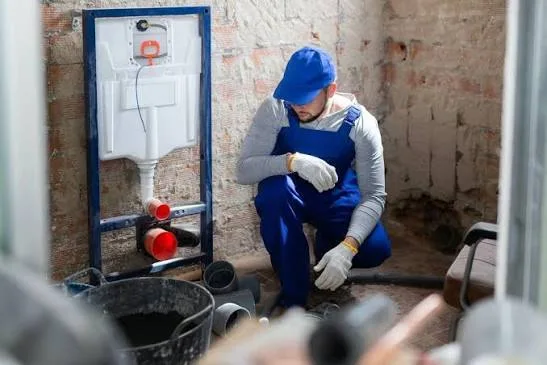
When a sewage backup floods a finished space during a sewer job, or a cross-connection lets a contaminant into a potable line, most plumbing contractors assume their general liability will answer. Usually it will not. The standard commercial general liability policy carries a pollution exclusion that carves sewage, contaminants, and fuel or gas out of its coverage — and those are precisely the exposures drain, sewer, and gas work create most. The result is a gap that sits exactly where a plumbing loss is most likely to land.
The short version: a sewage release is not a standard general-liability claim, because the standard policy is deliberately built to exclude it. That is not a defect to argue around after a loss — it is the form working as designed, which is why a separate line exists. Pollution liability is that line, and its coverage page owns the full architecture of how it responds. This post is narrower: it explains why the exclusion exists, which plumbing exposures fall in the gap, and why the honest answer is a purpose-built line rather than a hope that general liability will stretch to reach the loss.
The pollution exclusion: why standard general liability steps aside
The reason a plumbing program needs a separate pollution line comes down to how the general liability policy is deliberately built. The standard commercial general liability form most policies start from carries a pollution exclusion. In plain terms, that exclusion removes bodily injury and property damage that arise out of the discharge, dispersal, seepage, migration, release, or escape of a pollutant from the policy’s core coverage.
Read that language against the work a plumbing contractor actually does and the problem is plain: sewage, other contaminants, and fuel or gas all sit squarely on the excluded side of that line. The exposures the general liability policy leaves out are the exposures the trade creates most. A sewer crew that clears a main and pushes a backup into a finished space, a drain job that releases a contaminant, a gas fitter whose line lets loose — these are the losses the standard policy was drafted to exclude, not to answer. Understanding that upfront changes how a contractor reads a policy, because it means the pollution question cannot be settled by looking at the general liability limit.
Sewage backup: the release that defines the gap
Sewage is the exposure that defines this gap for a plumbing contractor. Drain and sewer work puts your crew and your completed work directly in the path of the substance the general liability policy most clearly excludes. A main you clear that backs up into a finished basement, a line you repair that releases into an occupied building, a sewer job where the flow escapes onto a neighboring property — these are the everyday realities of sewer and drain work, not rare events.
What makes a sewage backup more than an ordinary property-damage loss is what the substance is. A sewage release is not clean water; it is a contaminant, which is exactly why the general liability policy treats it as a pollutant and carves it out. The harm runs past the immediate water damage to the contamination and the cleanup a release demands — and it is that character, not the volume of water, that lands the loss on the excluded side of the seam. For a contractor whose book includes sewer and drain work, this is the exposure that makes a separate pollution line the difference between a covered loss and an argued one.
Contaminant discharge during drain and sewer work
Beyond sewage itself, plumbing work can discharge other contaminants, and those land on the same excluded side of the line. A cross-connection that lets a contaminant into a potable supply, a chemical or contaminant released during the work, a discharge from your operation that reaches soil, water, or a building — each reads as a release of a pollutant under the general liability exclusion. The whole discipline of backflow prevention exists precisely because a plumbing system can let a contaminant into a potable line if a connection is wrong.
The point a contractor has to hold onto is that a contaminant discharge is a pollution event even when it does not look like the stereotype of pollution. It does not take a spill of an industrial chemical for the exclusion to bite. A cross-connection that introduces a contaminant into a potable line is a release of a pollutant in the eyes of the general liability policy, and it falls in the gap the same way a sewage backup does. Reading whether your coverage reaches the contaminant exposures your specific work creates — sewer, drain, backflow, or otherwise — is exactly the work of matching a policy to an operation rather than assuming the general liability limit settles it.
Fuel and gas-line incidents
The third exposure sits with the contractors who do fuel-line and gas-line work, and it is where the pollution gap and the severity end of the operation meet. A fuel or gas release — a line that leaks, a connection that fails, fuel that escapes on the job — is a pollution event, because gas and fuel are pollutants the general liability policy excludes just as it excludes sewage and contaminants.
It helps to draw this next to general liability rather than blur the two. The fire-or-explosion severity of a gas failure — the third-party bodily injury and property damage of the most serious kind — sits with general liability as an operations exposure. The release of the fuel or gas as a pollutant, and the contamination and cleanup a release brings, sits on the other side of the seam. A gas program can touch both lines at once, which is exactly why a plumbing contractor doing fuel or gas work should understand where each one answers rather than assume a single policy reaches the whole exposure. The pollution liability page walks through how that division plays out on a gas program in detail.
The exclusion is by design, not a drafting error
The temptation, after a sewage or gas loss, is to treat the pollution exclusion as a technicality — a bit of fine print to be argued around. It is not. The exclusion is the standard general liability form working exactly as it was drafted to work, and every plumbing contractor’s policy is likely to carry it. Reading it as a mistake wastes the time and attention a contractor cannot spare once a release has already happened and a third party is looking for someone to answer for it.
Real-World Scenario: A sewer and drain crew is called to clear a blocked main in a commercial building. During the work the line backs up and a sewage release reaches a finished, occupied space on the level below, contaminating flooring and stock and forcing a cleanup. The property owner brings a claim for the damage and the cost of remediating the contamination, naming the plumbing contractor. Because the loss arose out of the release of a contaminant, it landed on the excluded side of the standard general liability policy, and the general liability limit did not respond to it. The exposure ran instead through the contractor’s separate pollution line — the coverage written for exactly this kind of release. Had the contractor carried only general liability and assumed it would stretch to reach a sewage backup, the argument would have started after the loss, at the worst possible time to discover where the seam actually sits.
How pollution liability closes the gap
Pollution liability exists to answer the exposures the general liability policy deliberately leaves out. Depending on the wording, it responds to the third-party bodily injury and property damage a release causes and, in many forms, the cost of cleaning it up — the sewage backups, the contaminant discharges, and the fuel-or-gas incidents that fall in the gap. It is not a rider that patches a broken policy; it is a distinct line built for a distinct exposure, carried alongside general liability rather than in place of it.
Because pollution coverage is largely a manuscript line, the exact terms vary more than they do on a standard form, and that is precisely why the wording matters. Whether your coverage reaches sewage, contaminant discharge, and fuel or gas — and whether it answers cleanup costs as well as third-party harm — depends on the specific policy in front of you. The coverage page owns that architecture in full; the takeaway here is narrower and firmer: the general liability policy is not going to answer a sewage backup, so the pollution line has to.
Reading your coverage against the work you do
The honest instruction is straightforward. A sewage backup, a contaminant discharge, or a fuel-or-gas release during plumbing work is not a standard general-liability claim, because the standard policy is built to exclude it. That is not a flaw to argue around after a loss — it is the form working as designed, and the response is a separate pollution line rather than a hope that general liability will reach the exposure. The commercial plumbing work where drain, sewer, and gas exposures concentrate is exactly where this gap matters most.
Read what your specific policy actually carries against the work you actually do: whether your book includes sewer and drain work, backflow and cross-connection work, or fuel and gas lines, and whether the pollution wording reaches each of those. When you are ready, start a quote and tell us where your work sits, or read the full pollution liability page to see exactly how the line responds to the releases general liability leaves out.