
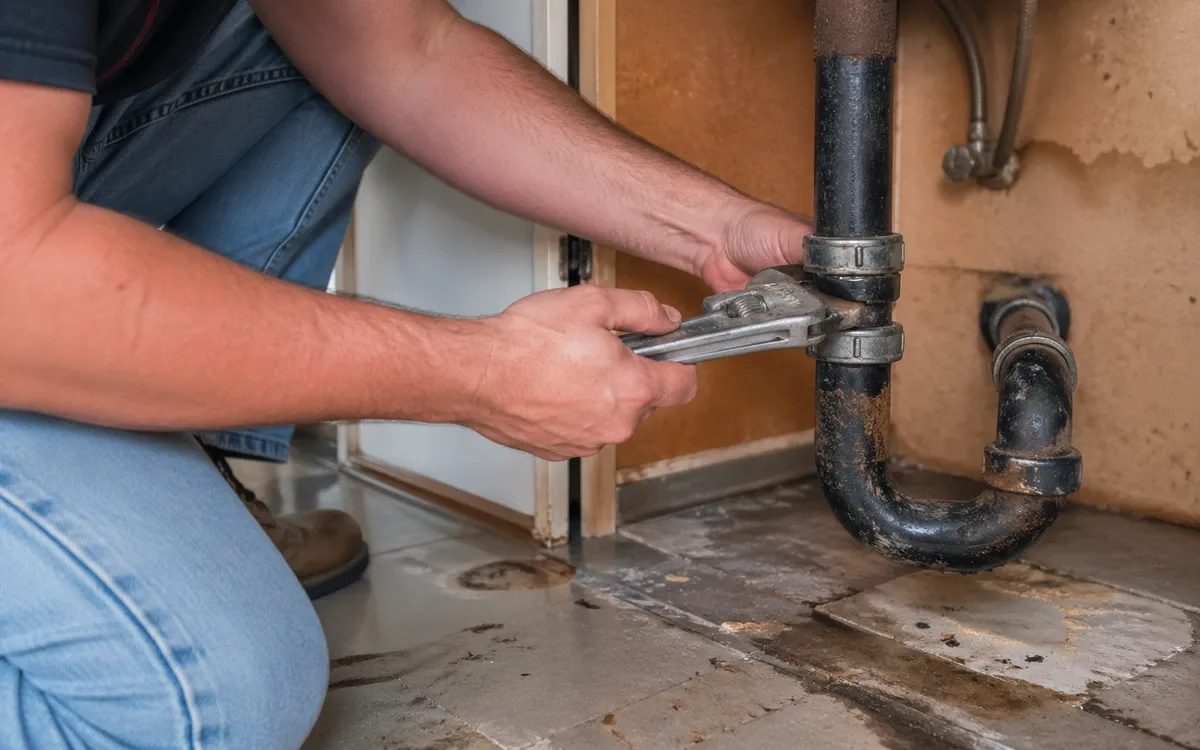
Every plumbing service call rolls out on wheels: a truck or van, and the tools, sewer cameras, pipe locators, and drain machines riding in it. When something goes wrong — a collision on the way to a job, a stolen van, a load of gear taken off a site — most contractors reach for one policy and expect it to answer for all of it. It will not. The vehicle and the gear inside it are covered by two different lines, and neither of them is the on-site general liability that covers the work itself.
The short version: your service trucks and vans run through commercial auto, and your tools and equipment run through contractors equipment, an inland marine line. They are distinct coverages that answer for distinct things, and assuming a single policy reaches the truck, the tools, and the work at once is the mistake that leaves an operation short. The two coverage pages own the full architecture of each line; this post is about how the split actually works — which line covers the truck, which covers the gear, and why the difference matters when a claim lands.
Two lines, not one: the truck and what rides in it
The cleanest way to hold this is to picture a service truck pulling up to a job. The truck is one exposure. The gear inside it is a second. The work the crew is about to do is a third. Three exposures, three lines — and a plumbing operation that treats them as one policy is the operation most likely to find the gap after a loss rather than before.
Commercial auto covers the vehicle. Contractors equipment covers the movable gear. General liability covers the on-site work. None of the three reaches all the way across to answer for another, and that is not a quirk of one carrier’s forms — it is how these lines are built. The value in understanding the split is practical: when a claim comes in, the first question is which exposure it belongs to, and knowing the answer before it happens is what keeps a covered loss from turning into an argued one.
Commercial auto: the vehicles you drive to the job
Commercial auto is the line for the trucks and vans a plumbing operation drives. It does two main jobs. First, auto liability answers for the harm your vehicles cause on the road — the bodily injury and property damage a plumbing truck can cause in a collision, which is the exposure that grows with every mile a fleet runs. Second, physical damage coverage pays for your own trucks and vans after a covered loss, whether that is a collision, a theft of the vehicle, or another peril the policy names.
What a plumbing contractor has to keep straight is that this line is about the vehicle, not its contents. Physical damage coverage restores the truck; it does not restore the sewer camera that was inside it. That boundary is where operations most often get surprised, because the truck and the tools feel like a single asset when they roll down the road together — but they answer to two different lines the moment a claim is filed.
The covered-auto form and its symbols
Commercial auto is built on a standard framework. The auto liability and physical damage coverages are set by the standard Business Auto Coverage Form, known in the ISO system as CA 00 01 — though editions vary by carrier, so the form on your policy is a starting point to confirm rather than an assumption. What makes the form worth understanding is the mechanism it uses to decide which vehicles a given coverage applies to: the covered-auto symbols.
A symbol is shorthand for a category of vehicles. The one every plumbing operation should know is the hired-and-non-owned pair, because it is the exposure that most often catches an operation off guard. In the Business Auto system, symbol 8 designates hired autos — vehicles you rent, lease, or borrow, such as a truck brought in for a large job. Symbol 9 designates non-owned autos — vehicles you do not own but that get used for the operation, such as an employee’s own car run on a parts errand. A plumbing business does both of these things routinely, and whether that exposure is covered depends on which symbols your policy actually shows. That is a line worth reading rather than assuming, because a coverage that looks complete on the vehicles you own can still leave the borrowed truck and the employee’s car outside it.
Contractors equipment: the inland marine line for your gear
The tools, sewer cameras, pipe locators, drain machines, and staged fixtures a plumbing crew carries are covered by a separate line: contractors equipment. It sits inside a category called inland marine — an older insurance term for property that moves rather than staying at one fixed address. That heritage is exactly why the line fits the trade so well, because a plumbing operation’s gear is in near-constant motion between the shop, the jobsite, and back.
The defining feature of contractors equipment is that it follows the gear rather than the location. It is written to cover your movable equipment on the jobsite, in transit between jobs, and often in storage — wherever the tools actually are, rather than tying coverage to a single address. That is why it answers questions the auto policy cannot: the sewer camera that goes down with the van in a fire, the drain machine stolen off a site, the pipe locator damaged in transit. Each of those is gear, not vehicle, and each runs through this inland marine line. How a loss settles — and where the line stops — is the province of the coverage page; the point here is simply that the tools have their own policy, distinct from the truck that carries them.
Where each line stops — and where general liability sits
Holding the seams straight is the whole point. Commercial auto stops at the vehicle; it does not restore the gear inside it. Contractors equipment stops at the movable gear; it does not answer for harm the truck causes on the road, and it does not cover the on-site work. General liability sits apart from both, answering for the third-party bodily injury and property damage that arise from the plumbing work itself — not the vehicle, not the tools. Three exposures, three lines, each with its own edge. The reason it matters is that a single loss can touch more than one edge at once: a break-in that damages the van and takes the gear inside it splits cleanly across two policies, and knowing which half goes where is what turns a confusing claim into a covered one.
Real-World Scenario: A plumbing crew parks its van outside a commercial job and works inside for the afternoon. When they come out, the van has been broken into: the vehicle itself is damaged at the door and window, and the sewer camera, pipe locator, and a set of drain machines that were inside are gone. Two different lines answer the two different halves of that loss. The damage to the van is a commercial auto physical-damage question. The stolen sewer camera, pipe locator, and drain machines are a contractors equipment question, because they are gear that runs through the inland marine line rather than part of the vehicle. An operation that carried only the auto policy, assuming it reached everything the van held, would have found the truck restored and the tools uncovered — with a full replacement of the gear coming out of pocket at the worst possible time.
Reading your policy against the fleet and gear you run
The takeaway is direct. A plumbing service truck and the equipment riding in it are covered by two different lines, and neither one is the on-site general liability that covers the work. The vehicle runs through commercial auto, with its covered-auto form and the symbols that decide which vehicles a coverage reaches. The tools, sewer cameras, pipe locators, drain machines, and staged fixtures run through contractors equipment, the inland marine line that follows the gear. Treating a single policy as if it reaches the truck, the tools, and the work all at once is the assumption that leaves an operation short.
Read what your policy actually carries against the fleet and the gear you actually run: which vehicles you own, rent, and borrow, which symbols your commercial auto shows, and whether your contractors equipment reaches the specific gear that leaves your shop every morning. When you are ready, start a quote and tell us what you drive and what you carry, read the commercial auto and contractors equipment pages to see how each line responds in detail, or browse the coverage overview to see where every line sits.