

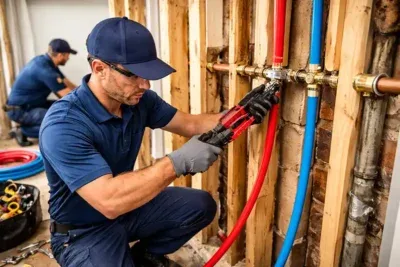
A one- or two-person plumbing company usually pays about $400 to $800+ for the year for general liability. That is our agency’s nationwide estimate for general liability only, not a quote, and some small companies land above it. The rest of the budget depends on a few decisions that only a very small company has to make: whether the second person is a partner or an employee, whose truck goes to the job, and what tools ride in it.
What does that general liability estimate actually buy?
It buys the policy that answers when your work hurts someone else or damages their property. For a plumber that usually means water damage: a fitting that fails behind a wall, a supply line that lets go after you leave, a drain you cleared that backs up the next day. General liability also answers when a customer trips over your hose or your crew damages a finished floor while working.
The estimate covers that single line. It does not include workers compensation, commercial auto or tools coverage, which are separate policies with their own prices. It also assumes ordinary limits for a small trade contractor. If a contract asks for higher limits or a long list of endorsements, the number changes.
Completed operations is the part of the policy a small plumber relies on most. Your work keeps holding water pressure long after the invoice is paid, and a leak months later can still come back to you. Make sure the policy you buy includes it.
Why might your quote land above the range?
The plus sign is there for a reason. These are the most common things that move a small plumbing company toward the top of the range or past it:
- The kind of work. Gas line work, sewer and drain work and new construction for builders tend to price higher than straightforward service and repair.
- The state. Liability costs vary by state, and so do the rules that shape claims.
- A claim on record. Even a single prior claim can change how a carrier views a small account.
- No insurance history. A brand new company has nothing to show an underwriter yet, and some carriers price for that.
- Contract demands. Higher limits, additional insured endorsements and waivers requested by customers can add cost.
- Revenue. General liability for contractors is commonly rated on revenue or payroll, so a busy two-person shop can price above a quiet one.
None of these make coverage unavailable. They are simply the reasons the estimate is a range, not a single figure. The guide to what drives plumbing contractor insurance cost explains each driver in more depth.
The line our estimate covers
Is the second person an employee or a partner?
Whose truck goes to the job, and who drives it?
What rides in the truck overnight?
Is your second person a partner or an employee?
This is the question that changes a two-person budget more than any other. If the second person is an employee on your payroll, most states expect you to carry workers compensation, and the premium is built from that person’s payroll and the classification of the work. In North Dakota, Ohio, Washington and Wyoming, comp comes only from the state fund. In Texas, workers comp is generally elective for most private employers.
If the second person is a co-owner, the answer depends on the state and on how the business is organized. Many states let sole proprietors, partners and some company officers exclude themselves from coverage, while others treat certain owners differently. Excluding yourself lowers the bill, but it also means your own injury on the job is not covered by the policy. Ask your agent to explain the trade, and confirm the rule with your state.
Be careful with helpers paid as contractors. A helper who works your jobs under your direction may be treated as your employee at audit, whatever the paperwork says. The post on what drives plumbing workers comp costs explains how classification and payroll shape the price.
Real-World Scenario: A licensed plumber who has worked alone for a while brings on a longtime friend to help with water heater installs and pays the friend as a contractor. At the end of the year the liability carrier audits the policy and asks who performed the work. The friend has no insurance, works only on the owner’s jobs and uses the owner’s tools and truck. The carrier treats the friend as part of the company’s own exposure, and the owner learns that workers comp was expected all along. The owner sets the friend up on payroll, buys a comp policy and reports the change before the next renewal.
Does the truck you drive to jobs need its own policy?
Often, yes. Many owner-operators start out driving a personal pickup or van to jobs. A personal auto policy may not respond to an accident that happens while the vehicle is being used for business, depending on the policy and how you use it, and a loaded work truck is a business use by any measure.
The fix depends on who owns the vehicle and how it is used. A truck titled to the company usually belongs on commercial auto. A personal vehicle used for work may need a business use endorsement or a commercial policy. The post on personal versus commercial auto for plumbers walks through those choices. If your partner drives a personal vehicle to jobs too, the same question applies to that vehicle.
What about the tools in the truck?
A small company’s tools are often worth more than its bank balance. A drain machine, a camera, press tools and a pipe threader are expensive to replace and easy to steal. The commercial auto policy covers the truck, not what is inside it.
Contractors equipment coverage is the usual answer for tools that travel. Schedule the expensive items individually, and ask how the policy treats tools left in a locked vehicle overnight, because some forms set conditions for that. For a very small company this line is often the last one added, but it is worth pricing once your tools would be hard to replace out of pocket.
Which costs come with the policy besides the premium?
A few, and it helps to know them before you sign. Many small policies are written at or near a carrier’s minimum premium, so trimming coverage may not lower the bill much. General liability and workers comp are commonly audited after the term ends, and if your actual revenue or payroll came in higher than the estimate, you can owe more. Some carriers charge for certain endorsements, and installment plans can carry fees.
None of these are reasons to avoid coverage. They are reasons to give accurate estimates up front and to read the payment terms on the quote.
Ask, too, whether the quote is for a policy written on an occurrence basis or a claims-made basis. Plumbing general liability is commonly written on an occurrence basis, which answers claims for damage that happens during the policy period whenever the claim is made. A claims-made policy can look less expensive at first but works differently when you change carriers or close the business. For a trade whose leaks can surface long after the job, that difference is worth understanding before you compare prices.
How do you keep the cost down without leaving a gap?
Describe your work accurately, so you are classified for the plumbing you actually do and not for riskier work you do not. Keep a clean claims record by documenting jobs, photographing finished work and handling small complaints before they become claims. Choose a deductible you could actually pay. Buy the limits your customers and contracts require, and add more when the work calls for it rather than in advance.
Above all, keep the general liability in force. The post on low-cost insurance for a new plumbing business explains why the order you buy coverage in matters more than the price of any single line. If you are getting covered so you can apply for a license, read where a new plumber can get insurance to get licensed as well.
What turns the estimate into a real quote?
Your own information. Have a short description of your work, your expected revenue, whether the second person is a partner or an employee and that person’s pay, your vehicles and who drives them, a list of expensive tools and any past claims. With those, an agent can price the general liability and tell you what the other lines will add.
The NAIC’s small business insurance overview is a helpful plain-language primer on the main policies, and its guide on how to choose an insurance agent is worth a look before you start calling around. As the company grows, the guide to residential plumbing insurance cost as you add trucks and crews picks up where this one leaves off.
When you are ready to turn our estimate into a number you can budget against, request a quote with your details. To learn who will be reviewing it, read about Wexford Insurance.