

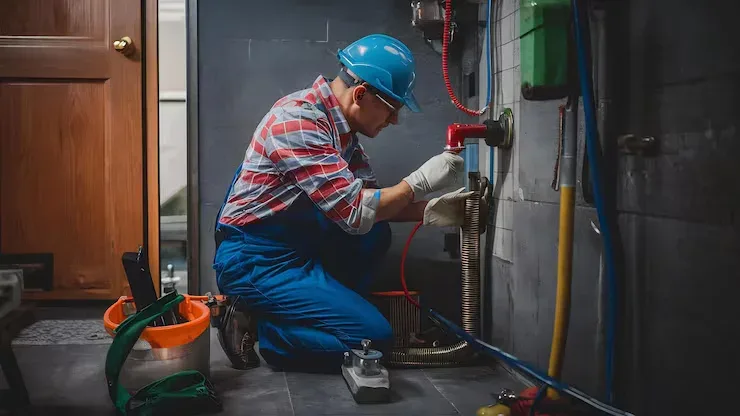
A plumbing contractor working in Hartford, CT needs general liability, workers comp, commercial auto and coverage for tools, with two areas checked more closely than usual: pollution coverage for work on old sewer and service lines, and completed-operations coverage for freeze-season repairs. Those are the claims that Connecticut’s capital region tends to produce, so they are where the program earns its keep.
What does a Hartford plumbing contractor need to carry?
The core is the same as anywhere. What changes is how closely each piece needs to be read.
- General liability for injury and property damage to others, including completed operations for damage that shows up after the job.
- Pollution liability for sewage and contaminant releases that the standard liability form excludes.
- Workers compensation once you have employees.
- Commercial auto for vans and trucks.
- Contractors equipment for cameras, jetters, locators and hand tools.
The Connecticut plumbing contractor insurance page explains the statewide licensing and exposure picture. This post looks at what working in and around Hartford adds to it, and ends with a pre-winter checklist you can run against your own policies.
Why does sewer work in older Hartford neighborhoods raise a pollution question?
Because the pipes and what flows through them are old. Hartford carries downtown commercial systems alongside old combined sewers and aging service lines, and drain and sewer work on those systems is exactly where a release of sewage or contaminants can happen.
Most general liability policies contain a pollution exclusion. Depending on the wording, a carrier may treat sewage released during your work as a pollutant, which can leave a backup into a basement unit outside the liability policy entirely. Some forms restore limited coverage by endorsement. A separate pollution policy is the more direct answer for crews doing this work regularly.
Ask your agent three questions: what the pollution exclusion on your liability form says, whether any endorsement gives some coverage back, and whether a separate pollution policy makes sense for the share of your work that touches sewer lines. The post on pollution liability and sewage backup coverage goes through how those claims tend to unfold.
Sewer repair can also mean digging and entering manholes or vaults, which brings trench and confined-space hazards to your crew. That side of the exposure belongs on workers comp, and the post on workers comp for trench and confined-space work covers it.
What does a hard Connecticut winter do to your liability exposure?
It concentrates it. Hard winters and a deep frost line make frozen and burst pipes the defining seasonal exposure in Connecticut. When a cold snap arrives, thaw work, repipes and emergency calls arrive with it.
The liability side of that work runs on completed operations. A connection made in an unheated space during a rushed emergency call can hold through the visit and fail when the next freeze comes, flooding a finished area. The claim is about your finished work, and how the policy treats it depends on the completed-operations coverage and on how the form handles the cost of redoing your own work.
Older housing stock across the region makes this sharper. Tight crawlspaces, mixed pipe materials and earlier repairs by others all complicate the job and the later question of what failed. Document what you found and what you changed, with photos when you can.
Vacant and seasonal properties deserve a word of their own. A crew called to restore water in an empty unit or a building between tenants may finish the repair and leave a space with little or no heat. If the line freezes again, the question of who was responsible for keeping the space warm can decide the claim. Note on the work order what you told the owner or manager about heat, drain-down and shutoffs, and keep that note with the job file.
It also helps to tell your underwriter how emergency work is handled. A company that sends a licensed plumber to every after-hours call, follows up with a check visit and records the outcome reads differently from one that cannot describe its process.
How do the P-1 and P-2 licenses show up when a carrier reviews your crew?
They tell the underwriter who is authorized to run the work. Connecticut licenses plumbers statewide through the Department of Consumer Protection under the Plumbing and Piping Work Examining Board, using the P-1 contractor and P-2 journeyperson licenses.
On the application, list who holds which license, how apprentices and helpers are supervised, and what work the business performs. A carrier writes the policy around the business named on it, so the licensing picture and the description of work should line up. The Connecticut cost guide explains how that labor mix feeds the price.
Be precise about scope as well. Plumbing and piping work in Connecticut can reach into areas such as gas piping, water treatment or fire protection, and each one can change how a carrier views the account. If your crew performs any of that work, describe it plainly and say how often it happens. Leaving it off the application does not remove the exposure, it only leaves the policy written around a smaller business than the one you run.
What do property managers and general contractors around Hartford ask for?
They ask for proof, and often for more than proof. Multifamily buildings, institutional properties and commercial owners in the capital region commonly hire plumbing contractors under service agreements or subcontracts that include an insurance section.
Typical requests include additional insured status, sometimes extending to completed operations, a waiver of subrogation, and minimum limits for each policy. A property manager with several buildings may want a certificate on file before any crew arrives and an updated one at every renewal.
Read each agreement before the first call rather than filing it away. Service agreements are often signed once and forgotten, yet their insurance terms apply to every job performed under them, including the emergency call that arrives in the middle of a winter night.
That makes certificate handling part of the job. A missed renewal certificate can hold up payment or put a service agreement at risk. The post on how small plumbing businesses avoid missing certificate renewals has a system for keeping them current.
Real-World Scenario: A Greater Hartford plumbing contractor holds a service agreement with a property manager for several older apartment buildings. During a main-line clearing job, sewage backs up into a basement unit, damaging flooring and a tenant’s belongings. The liability carrier points to the pollution exclusion on the form. Because the contractor had added a separate pollution liability policy after reviewing the sewer share of the business, that policy responds to the cleanup and the tenant’s claim, and the service agreement stays in place.
How should crews and vans working across Greater Hartford be insured?
Insure them for how they actually move. A Hartford shop may run calls from the city into the surrounding towns and along the river, with vans parked at jobsites, at employees’ homes and at a shop.
Commercial auto should list every vehicle and every driver, with the garaging location for each. Tools and equipment belong on contractors equipment coverage, with expensive items such as cameras and jetters scheduled individually. Ask how the policy treats equipment left in a locked, unattended van overnight, since conditions on that point vary.
Winter driving adds weight to the auto side. Emergency calls in snow and ice put crews on the road at night in poor conditions. A clean driver list and a simple vehicle-use policy help an underwriter see that the company manages that risk.
What should you check before the heating season starts?
Run this check each fall, before the first hard freeze.
Each item maps to a claim the season tends to produce. Your declarations page is the quickest place to confirm limits, policy periods and listed vehicles, and the NAIC explains what a declarations page shows if you have not read one closely before.
If anything on the list comes back wrong, fix it before the first cold snap rather than after the first claim. Most of these changes are routine endorsements or schedule updates that an agency can make mid-term, and they are far easier to arrange when no loss is waiting on the answer.
How do you get a quote started from Hartford?
Gather your P-1 or P-2 license details, payroll by role, vehicle and driver list, tool schedule and recent loss runs, then describe your work mix: service, freeze-season emergency, drain and sewer, remodel and new construction. If you are unhappy with your current agent, the post on whether to switch insurance agents can help you decide. The Connecticut Insurance Department can confirm that an agency is licensed in the state.
When the records are together, ask us for a Hartford-area quote, or read about our background placing plumbing contractors before you reach out.