

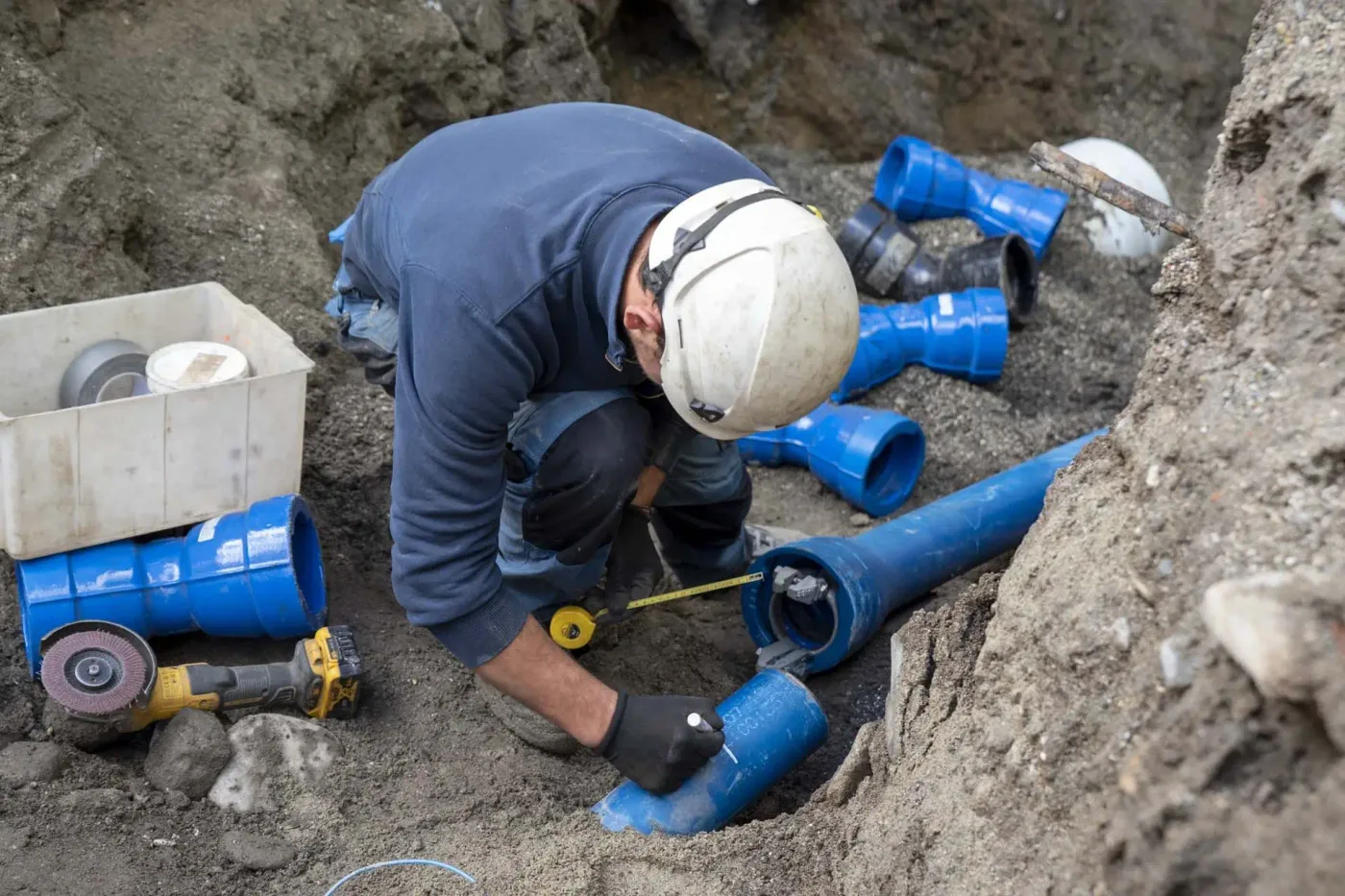
To get plumbing business insurance in Indiana, gather your Plumbing Commission credential, payroll, vehicle and claims records, describe the work your crew performs, and have an agency that places plumbing contractors quote general liability, workers comp and commercial auto together. The rest of this guide walks through each step in the order an owner actually meets them.
This is general education, not legal advice. Licensing and coverage rules can change, so confirm anything that affects your license or your contracts with the authority that sets it.
What does an Indiana plumbing business usually end up carrying?
Most Indiana plumbing companies build their program from a core of four policies, then add to it as the work demands.
- General liability for injury or property damage your work causes to others, including the completed-operations exposure that follows a job after you leave.
- Workers compensation once you have employees, written by private carriers in Indiana.
- Commercial auto for the service vans and pickups.
- Contractors equipment for tools, cameras, jetters and locators that travel to jobs.
From there, drain and sewer work raises the question of pollution liability, and larger contracts often lead to an umbrella. The Indiana plumbing contractor insurance page describes the state’s exposure mix in detail. This guide is about the process of getting covered, not the list itself.
Where does your Plumbing Commission credential fit into the application?
It fits at the front, because it tells the underwriter who stands behind the work. Indiana licenses plumbers statewide through the Indiana Plumbing Commission under the Professional Licensing Agency, with apprentice, journeyman and plumbing contractor credentials. There is no separate master tier, so the plumbing contractor credential is the top of the ladder.
That structure keeps the conversation simple. The person holding the contractor credential and the business named on the policy are usually closely tied, and the application should make that link plain. List who holds which credential, who supervises apprentices, and which jobs each person runs.
If you are still moving up from journeyman, say so. An underwriter would rather hear about a licensing step in progress than discover it later. For the bigger picture of how licensing differs from state to state, see do plumbers need a license.
What should you have on the table before you ask for a quote?
Have the records an underwriter will ask for, gathered once, in one place. Missing records are the most common reason a quote takes longer than it should.
- Your Plumbing Commission credential details and the business’s legal name and entity type.
- Payroll split by the work each person does, with owners and office staff shown apart from field crews.
- A list of vehicles with drivers, plus how the vans are used and where they are kept.
- A schedule of tools and equipment with rough replacement values in your own records.
- Prior policies and loss runs from your current or past carriers.
- A short description of your work mix: service and repair, remodel, new construction, gas, drain and sewer, water treatment.
New companies will not have loss runs. That is normal. A clear description of the work and the owner’s experience carries more weight in its place.
Established companies should request loss runs early, since carriers can take a while to send them. Ask for them from every carrier you have used in recent years, including any you left on bad terms, because an underwriter will notice a gap in the history and ask about it anyway.
Credential, payroll by role, vehicles, tools, loss runs.
Service, remodel, new systems, gas, drain and sewer.
Markets that write plumbing work like yours.
Read exclusions, classifications and conditions before price.
Policies issued, certificates sent to whoever asks.
How do you describe Indiana work so the quote fits it?
Describe it by what your crew does on an ordinary week, not by the broadest label available. A carrier prices and words a policy around the description it receives, so a vague answer can produce a policy that fits someone else’s business.
Indiana gives you specific things to mention. Hard water and mineral scale foul fixtures, valves and water heaters across much of the state, which keeps softener, filtration and heater replacement work steady. Seasonal freeze drives repipe and emergency calls in winter. Both matter because a failure on finished work can surface well after the job, and that is a completed-operations question on the liability policy. The post on water damage and completed operations explains how that claim is handled.
Be equally specific about the work you do not do. If you never touch gas lines or never dig, say so. If you do, describe how often and how the crew handles it. The cost side of these details is covered in the Indiana cost guide.
Who actually writes the coverage, and how do you reach them?
Carriers write the policies, and most plumbing contractors reach them through an agent. A captive agent offers one company’s products. An independent agency can approach several carriers and match each line to the market that fits it best, which matters for a trade that some carriers like and others avoid.
Ask any agent you talk to three things: how often they place plumbing contractors, which of your lines they can write, and who issues certificates when a general contractor needs one the same day. The NAIC offers a short consumer guide on how to choose an insurance agent that is a good starting checklist.
Expect some carriers to pass. A market that likes residential service work may decline a company with regular trench or gas exposure, and the reverse happens too. That is not a verdict on your business, only a mismatch with that carrier’s appetite, and it is the main reason to work with someone who can approach more than one.
You can also confirm that an agent or agency holds an Indiana license through the Indiana Department of Insurance, which regulates insurance sold in the state.
Real-World Scenario: An Indiana journeyman finishes the steps to work under a plumbing contractor credential and plans to hire a helper and buy a second van. Before the first job, a builder asks for a certificate showing liability and workers comp. The owner sends an agency the credential details, a payroll estimate for the helper, the van information and a list of tools. The agency places liability and comp with carriers comfortable with new residential service companies, adds the vans to a commercial auto policy, and issues the certificate to the builder before the start date.
What happens between the application and the first certificate?
The agency submits your information to the carriers it chooses, and each carrier either offers terms, asks questions, or declines. Questions are normal. Answer them promptly and in writing, because the answers become part of the record the policy rests on.
When proposals come back, read them side by side before looking at totals. Check the classification on the liability and comp policies, any exclusions tied to gas, sewer or excavation work, and whether the completed-operations coverage matches the work you do. The post on how to read a plumbing insurance policy shows where those terms live.
Ask about the practical terms as well: the deductible on each policy, how the premium is billed, and whether the liability and comp policies are subject to audit. Those details shape your cash flow more than owners expect, and they are easier to set at the start than to change mid-term.
Once you choose, the policies are bound and the agency can issue certificates. Give the agency a list of the general contractors and customers who need one, with the wording each contract requires, such as additional insured status.
When does an Indiana program need a second look during the year?
It needs a look whenever the business changes in a way the underwriter did not see. Adding employees, adding vehicles, taking on gas or sewer work, or signing a contract with new insurance terms are the usual triggers.
Tell your agent before the change when you can. A new type of work started without notice can fall outside the classifications on the policy, and a vehicle added without notice may not be listed when it matters. Mid-term changes are routine paperwork when they are reported on time.
Renewal is the scheduled checkpoint. Payroll is usually audited against actual figures after the term, so keep payroll records split by role all year. The post on where to get workers comp for plumbing employees covers how that audit tends to work.
Keep subcontractor certificates on file as well. If you hire another licensed plumber or an excavator for part of a job, collect proof of their liability and comp before they start. An auditor who cannot see that proof may treat what you paid them as your own payroll, and a claim caused by an uninsured sub can land on your liability policy instead of theirs.
How do you get started from anywhere in Indiana?
Start with the records list above, then call or send them to an agency that places plumbing work every week. Our office is in Greenwood, south of Indianapolis, and we place coverage for plumbing contractors across the state, from Fort Wayne and South Bend to Evansville and Bloomington.
When you are ready, start an Indiana plumbing quote with whatever records you have today, or read about our agency and Nate’s background first.